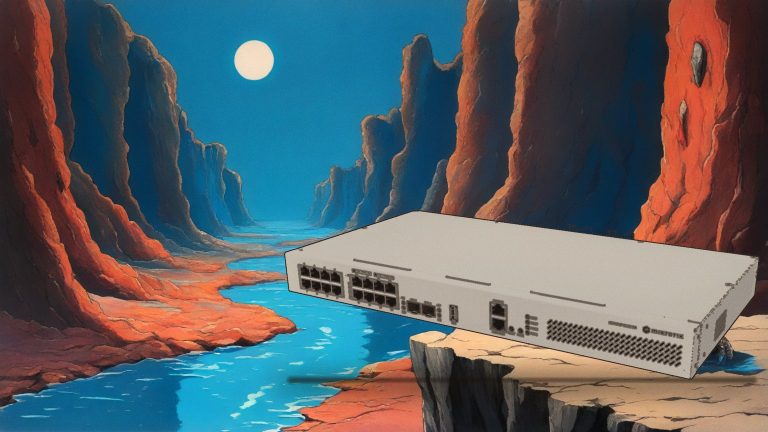
What is the MikroTik CRS812 DDQ?
The MikroTik CRS812 DDQ is a Layer 2/3 switch designed to operate as a top-of-rack node, campus core, or aggregation point for service providers. It uses a Marvell switching chip (model 98DX7335) paired with a 2 GHz quad-core 64-bit ARM CPU, ensuring advanced routing and traffic management capabilities typical of the RouterOS ecosystem. The device is sized for standard racks (443 x 268 x 44 mm) and supports redundant power supplies and hot-swap fans.
What are the main technical features?
The key specifications of the MikroTik CRS812 DDQ include:
- CPU: Quad-Core AL52400 at 2000 MHz (64-bit ARM architecture).
- Memory: 4 GB DDR4 RAM and 512 MB NAND storage.
- Ethernet ports: 2 RJ45 ports supporting 10M/100M/1G/10G.
- SFP56 ports: 8 ports supporting speeds from 1G to 50G (1G/2.5G/5G/10G/25G/50G).
- QSFP56 ports: 2 ports supporting speeds from 40G to 200G (40G/50G/100G/200G), with breakout support.
- QSFP-DD ports: 2 ports supporting speeds from 40G to 400G (40G/50G/100G/200G/400G), with breakout support.
- Operating system: RouterOS v7, license level 6.
- Power: 2 AC inputs (100-240 V), 12 V / 20.8 A power supplies.
- Power consumption: Maximum 81 W without accessories, 134 W with accessories.
- Operating temperature: From -10°C to +50°C.
Who is it for and in which scenarios does it make sense?
This device is suitable for network administrators who need to upgrade their infrastructure to 50G, 200G, and 400G speeds without replacing the entire network. It is ideal as a top-of-rack switch with 400G uplinks to the spine, as a campus core to connect legacy 10G devices to modern 50G interfaces, or as an aggregation node for service providers. It also finds application in labs, AI clusters, and media workflows where high-speed “east-west” traffic is critical.
What to know before choosing it?
Before purchasing, you must verify the compatibility of cables and transceivers with the SFP56 and QSFP-DD ports. MikroTik offers specific accessories for 400G, including 1 m and 3 m DACs (codes DDQ+DA0001 and DDQ+DA00031) and 100 m optical transceivers (DDQ+85MP01D). The QSFP56 and QSFP-DD ports support breakout mode for lower speeds, offering flexibility in connectivity. The device includes two power cables, rack ears, and a mounting kit.
Frequently asked questions
Does the MikroTik CRS812 DDQ support 400G?
Yes, the MikroTik CRS812 DDQ features two QSFP56-DD ports supporting speeds up to 400 Gbps, in addition to QSFP56 ports for 200G and SFP56 ports for 50G.
What operating system does the MikroTik CRS812 DDQ use?
The MikroTik CRS812 DDQ runs on RouterOS v7 with a level 6 license, offering the advanced routing and switching capabilities of the MikroTik ecosystem.
What physical ports does the MikroTik CRS812 DDQ have?
The MikroTik CRS812 DDQ offers 2 RJ45 Ethernet ports (up to 10G), 8 SFP56 ports (up to 50G), 2 QSFP56 ports (up to 200G), and 2 QSFP56-DD ports (up to 400G).
Does the MikroTik CRS812 DDQ have redundant power supplies?
Yes, the MikroTik CRS812 DDQ features two AC inputs for hot-swappable redundant power supplies, ensuring operational continuity in the event of a power supply failure.
Learn more on the MikroTik website: CRS812 DDQ page and official datasheet (PDF).