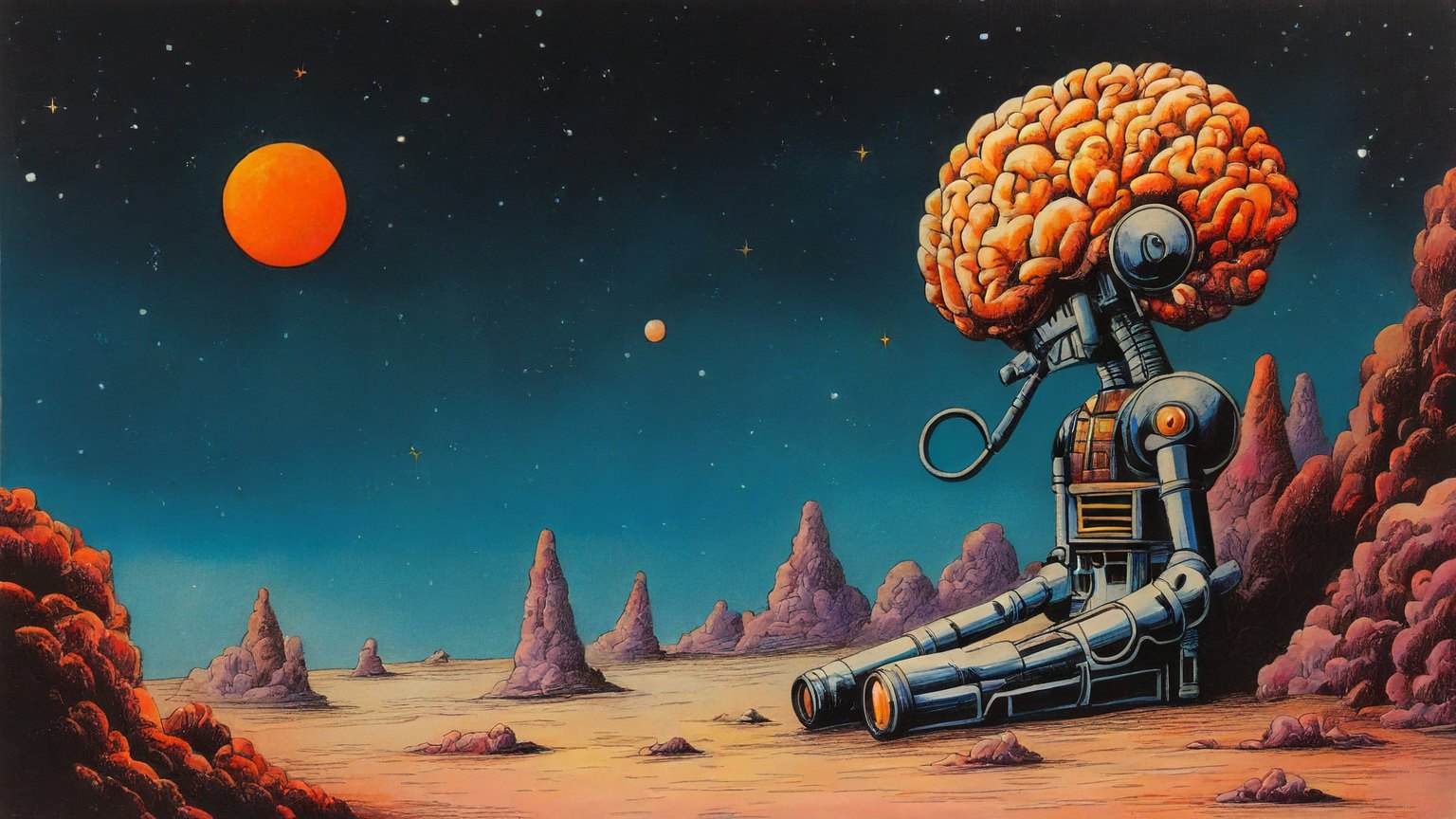
The illustrations at the top of MikroTik Dojo articles and courses are not photos or hand-drawn artwork: they are generated by a computer, at home, using a method that leaves a lot of room for chance. Here is how it works.
It is a technological experiment: seeing how far you can go with local tools to illustrate a technical blog in a fun, elegant, and always on-topic way, without repeating the same image twice.
The images are not intended to describe the topic in detail. They may hint at it with a few elements, but they are surreal by choice: they serve to entertain and decorate, without claiming to be an illustrated explanation.
Where are they generated?
Locally, on a server with a graphics card that I manage, using ComfyUI, a free program for composing image generation chains. No external service receives the texts or images, and no image is taken from the internet.
How is a header created?
Each image starts with a small random draw. For each section of the site (security, advisories, firmware, news, courses, products), there is a list of ingredients, and the program picks some at random:
- an environment: a castle, a port, a lunar colony, a machine greenhouse;
- a character, almost always a strange creature or a funny animal;
- an atmosphere ranging from horror to science fiction, steampunk, and Lovecraftian cosmic horror;
- the dominant color of the background, rotating;
- often, a chess touch: a tower used as a lighthouse, a crystal queen, pieces fallen like ruins.
For vulnerabilities, there is an extra ingredient derived from the topic: if the issue allows taking control, someone ends up at the helm in the scene; if it blocks a service, something collapses.
With these ingredients, a private language model, running locally on my servers, writes a brief description of the scene. From there, the image generator does the rest: composition, details, and gags are left to its creativity. The style is that of 1960s science fiction covers and 1970s progressive rock albums, thanks to a LoRA I trained specifically on this type of illustrations.
Two examples
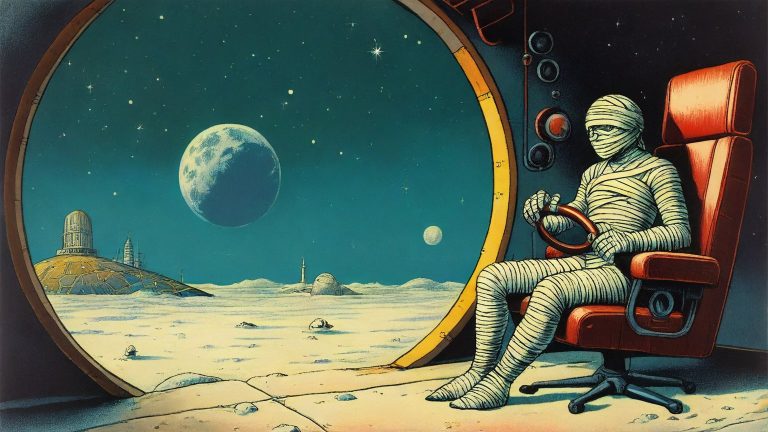
A vulnerability in the web service that allows an outsider to take control. The extracted ingredients were a lunar colony with a large round hatch (the entrance, i.e., the exposed web service), a mummy as the character, and, derived from the topic, the effect of “the intruder ends up in command.” The result: a mummy comfortably sitting in the commander’s chair, a joystick in hand. It does not explain the flaw, but the point gets across: someone who should not be there has taken the helm.
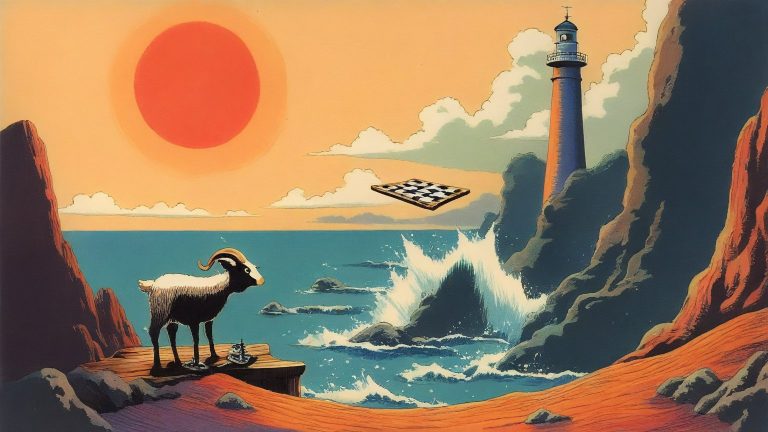
A warning from MikroTik: with certain versions, some LTE devices cause issues. The idea here is the danger being signaled: the lighthouse warning ships on the coast and a goat stopping right on the edge of the cliff, one step before the void. The chessboard flying among the clouds, however, means nothing: it is the randomly drawn chess touch, purely for the sake of the absurd.
Are there checks?
Yes, automatically: every image is examined by another local and private model capable of “seeing” images, which looks for text, human figures, or blank pages; if it finds any, the image is regenerated. Real people, brands, or invented logos do not appear in the scenes.
They remain decorative images: they do not contain technical information, and some details may come out strange or imperfect. That is part of the game.
Why an octopus?
Because those who do our job would need eight arms. On any given day, a network technician configures a router, answers the phone, chases a cable inside a rack, reads a changelog, and keeps an eye on monitoring at the same time. And MikroTik routers are the same: the same device handles routing, firewall, VPN, Wi-Fi, DHCP, and a dozen other things, all at the same time.
The octopus is the animal of multitasking: eight arms, and much of its neurons are located right in the arms, which can work independently. It also has three hearts: the redundancy we would want in every network. That is why in the dojo the sensei is a purple octopus, and those who enter the dojo are apprentice octopuses: they start with a white belt with still thin tentacles and grow, belt after belt.
Does an image bother you?
If for any reason an image seems inappropriate, offensive, or simply out of place to you, write to me at gianni@mikrotikdojo.com specifying the page: I will replace it as soon as possible.