MikroTik Dojo: RouterOS vulnerabilities, updates, news and MikroTik courses










Upcoming MikroTik courses
All dates →

From the blog
 Knowledge base
The PSD matcher in MikroTik: how RouterOS detects port scans
The PSD matcher in the RouterOS firewall detects port scans: it adds a weight for each different port touched by the same address within a short time window, and when the total reaches the threshold, the rule triggers. Usually, it places the scanner in an address list, and another rule drops it. Place it below the rules that accept legitimate traffic, and note that it does not detect slow scans.
 Knowledge base
MikroTik Firewall Filter: input, forward, output chains and rule order
The RouterOS firewall filter directs every packet into one of three chains: input (to the router), forward (through the router), output (from the router). In each chain, rules are read from top to bottom, and the first match with an action such as accept or drop ends the processing; if no rule matches, the packet passes. For this reason, a new rule must always be placed above the final drop, never below it.
 Knowledge base
MikroTik firewall address list: how they work in RouterOS 7
An address list is a named list of addresses that firewall rules use instead of a manually written address. You add the entries yourself (static) or the firewall adds them automatically as traffic passes (dynamic, usually with an expiration). This mechanism is the basis for blacklists, port knocking, management allowlists, and domain filters.
 Knowledge base
Interface list MikroTik: come funzionano e perché il firewall le preferisce
Una interface list è un gruppo di interfacce con un nome, per esempio WAN o LAN. Le regole del firewall, il neighbor discovery e il MAC server guardano la lista invece della singola porta: quando aggiungi una linea PPPoE, una LTE o una seconda WAN, la metti nella lista e le regole valgono subito anche per lei.
 Knowledge base
MikroTik IP Cloud: How RouterOS Dynamic DNS Works
IP Cloud is the free service that gives your router a fixed DNS name, serial-number.sn.mynetname.net, which follows the public IP address. The router asks the MikroTik server, "What address do you see me at?" and the name points to that answer, even behind a NAT. The name is used to find the router, not to open it.
 Firmware
RouterOS 7.23.8 long-term: fixes and security
MikroTik has released version 7.23.8 of the long-term channel, a conservative release designed for those who prioritize absolute stability. The update fixes a security vulnerability (CVE-2026-84411) and resolves several bugs related to IPsec, OSPF, and storage management. It is advisable to update production devices using the long-term branch after creating a full backup.
 Firmware
RouterOS channels: stable, long-term, testing, and development. Which one to choose?
RouterOS is released on four channels: long-term (the most conservative branch, receiving only critical fixes), stable (the recommended current version), testing (release candidates for the next version), and development (beta releases). Use long-term or stable in production; testing and development are for the lab. You select the channel in /system package update; files for all versions, including old ones, are in the [RouterOS Archive](https://mikrotikdojo.com/tools/archivio-routeros/).
 News
NewsNew SFP modules and hot-swap power supplies for MikroTik
MikroTik has updated its range of optical modules and backup power supplies. The new additions include two new SFP modules for extended distances and two hot-swap power supplies specifically designed for high-end switches and routers. These components are intended for those managing long-distance fiber links or requiring power redundancy on critical devices.
 Products
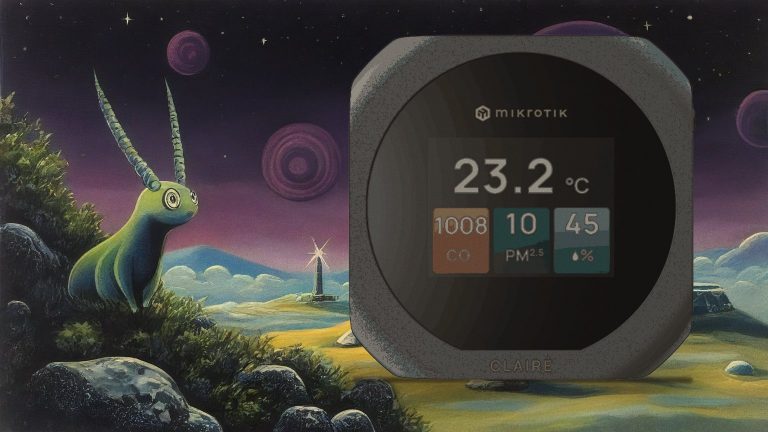
MikroTik CLAIRÉ: Indoor Air Quality Monitoring with Matter over Thread
The MikroTik CLAIRÉ is an indoor environmental sensor that measures CO₂, particulate matter (PM2.5/PM10), VOCs, temperature, and humidity. It is designed for those who want to monitor air quality in real time via a local display or integrate data into local smart home automations using Matter over Thread, without relying on external clouds.