The dojo blog.
Vulnerabilities explained with the commands to protect yourself, RouterOS updates to know before installing them, news and products — in English, from official sources.

New MikroTik SFP Modules for Fiber Optic Connections
MikroTik has introduced four new SFP and SFP+ modules to expand fiber optic connectivity options. These devices support speeds from 1G to 10G and are designed for backbone, campus, and ISP infrastructure. Prices start at $22 for multimode modules and go up to $139 for single-mode SFP+ pairs.
 Products
MikroTik CRS510-8XS-2XQ-IN: 100G Switch with 8 25G Ports
The MikroTik CRS510-8XS-2XQ-IN is a 100 Gigabit network switch designed to upgrade existing 10 or 25 Gigabit infrastructure. It stands out for its combination of two 100G QSFP28 ports and eight 25G SFP28 ports, hot-swap redundant power supplies, and backward compatibility with lower standards.
 News
MikroTik 60 GHz: PTP and PTMP backhaul for local WISPs
MikroTik has documented a real-world use case where local WISPs used 60 GHz solutions to create high-capacity backhaul. The project, implemented with Cooltech, used CubeG-5ac60ay Pair and Wireless Wire Dish for point-to-point and point-to-multipoint links. The implementation met bandwidth demand without requiring the adoption of other brands.
 Dojo
Basic hardening of a MikroTik router with RouterOS 7
A MikroTik just reset with no-defaults=yes has no firewall: perfect on the bench for learning, but never put it on a network like that. Before installing it you need seven hardening steps: update RouterOS, replace the admin user, turn off the services you don't use and limit the others to the authorized addresses, close the service ports on the external interfaces, a minimal firewall that blocks everything coming from the internet, and a VPN for remote management.
 News
Practical community examples: Doom on RouterOS and CAPman setup
The MikroTik newsletter presents two real-world use cases from the community. The first involves running the Chocolate Doom game inside a RouterOS container. The second illustrates a complex wireless configuration for environments with thick walls, using wAP indoor and outdoor units in CAPman mode.
 Products
MikroTik LAMP 5G R16: Outdoor 5G Device with eSIM
The MikroTik LAMP 5G R16 is a ruggedized outdoor 5G modem, designed for urban, port, and marine environments where network coverage varies. It stands out for its integrated omnidirectional antennas and native eSIM support, eliminating the need for physical antenna alignment or replacing traditional SIM cards.
 Products
MikroTik CRS312-4C+8XG-RM: 10G RJ45 and SFP+ switch
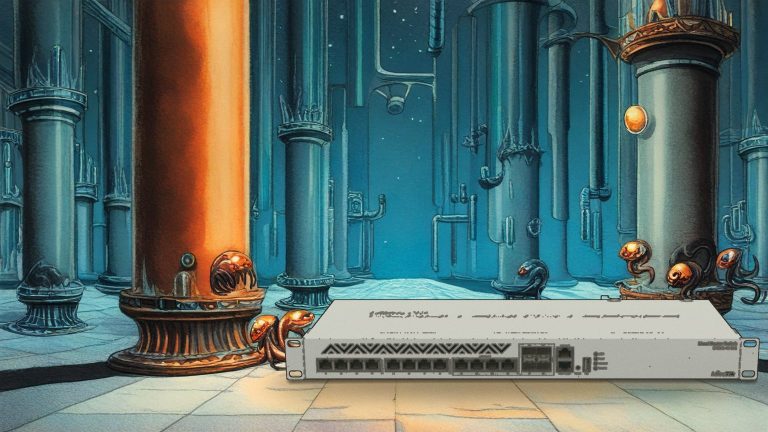
The MikroTik CRS312-4C+8XG-RM is the first switch in the MikroTik line featuring 10 Gbps Ethernet RJ45 ports. It is designed for professional environments requiring high speed and redundancy, offering a combination of RJ45 and SFP+ ports in a 1U rack format with redundant power.
 News
MTCINE Course in Lucca, July 2026: Understand the Flow Before Writing the Configuration
The MTCINE course concluded with a focus on BGP and MPLS, concentrating on the logical understanding of the underlying mechanisms.
 Products
CCR2004-1G-12S+2XS: MikroTik Router for SFP and SFP28 Management
The CCR2004-1G-12S+2XS is an enterprise-grade router designed for centralized management of high-speed optical interfaces. It targets WISPs and network administrators who need to aggregate 10G and 25G traffic in a single rackmount device, offering BGP and IPsec processing performance comparable to the CCR1009/CCR1016 models.
 Security
WebFig Exposed in Clear on RouterOS and SwOS
CVE-2025-61481 exposes the WebFig management interface of RouterOS v.7.14.2 and SwOS v.2.18 via unencrypted HTTP, allowing a man-in-the-middle attacker to inject JavaScript into the administrator's browser and intercept credentials. The vulnerability is classified as critical with a CVSS score of 10.0. To mitigate the risk, disable WebFig if not necessary or restrict access exclusively to the trusted management network.
 Dojo
Hotspot and PPPoE MikroTik: the username in every log line
A hotspot's connection log contains IP addresses, not people: to know who was behind an address you have to cross-reference it with the logins. With a login and logout script you can create a log rule for every connected user, with the username in the log-prefix: every log line already contains the name. It works with the hotspot (on-login / on-logout of the user profile) and with PPPoE (on-up / on-down of the PPP profile).
 Security
Buffer overflow in libjson.so of RouterOS 7
CVE-2025-10948 is a buffer overflow vulnerability in the parse_json_element function of the libjson.so component, reachable via the /rest/ip/address/print REST endpoint. It affects RouterOS 7 and can be exploited remotely. Updating to versions 7.20.1 or 7.21beta2 resolves the issue.
 News
MTCRE Course in Lucca, June 2026: Two Days to Truly Understand OSPF and Tunnels
An MTCRE edition at SICE focused on dissecting typical errors in dynamic routing and VPNs, with hands-on labs targeting doubts raised in class.